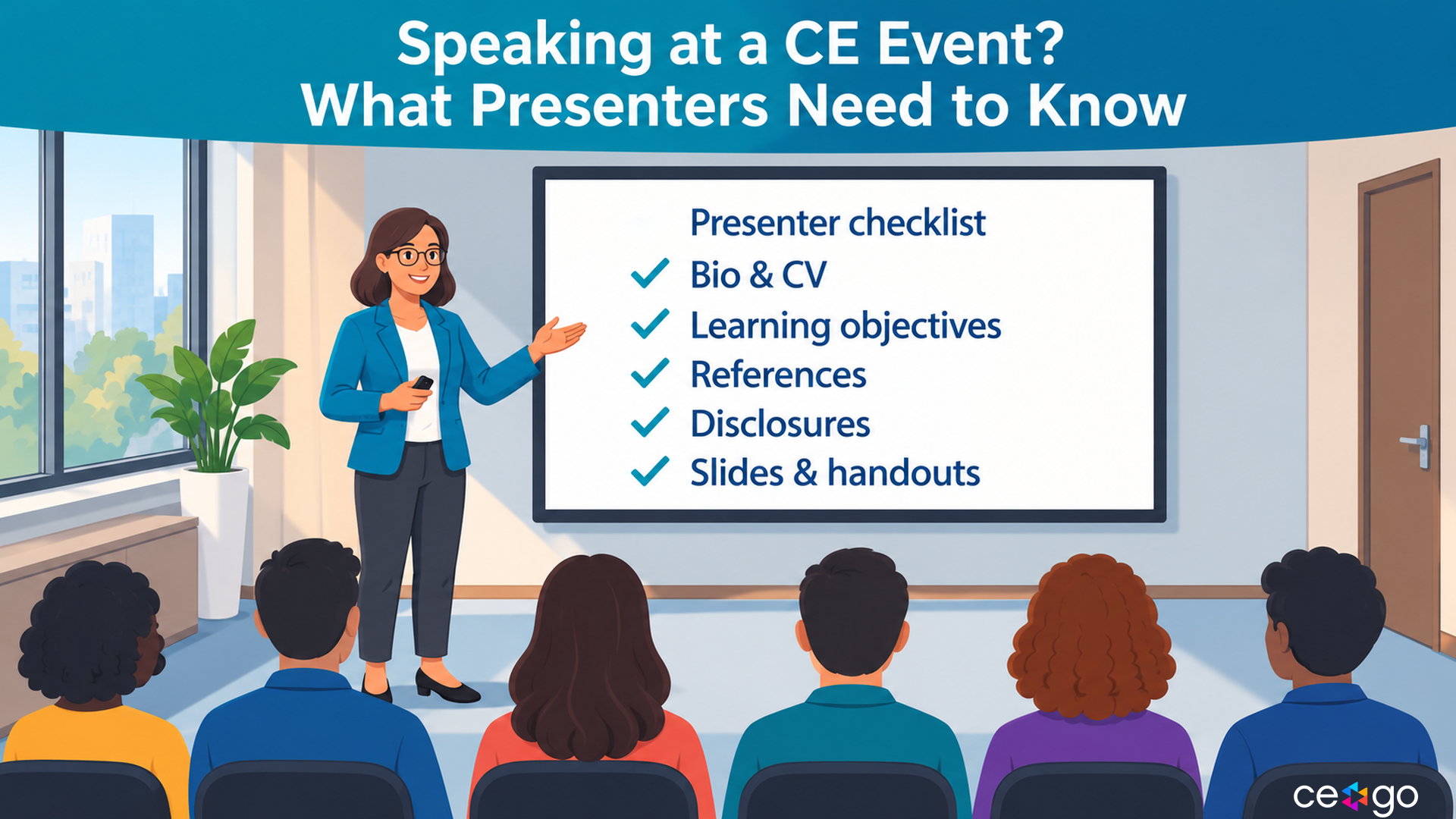
Presenting at a continuing education event is different from giving a regular talk. Before attendees can earn credit, CE reviewers need to see that your content is current, balanced and built around clear learning goals. That means a few extra items from you, usually well before the event.
This guide is for CE presenters or speakers. If you are an event organizer, it might be useful and time saving to share this guide with your presenters. Event organizers should check out our post on managing speakers and content workflows too.
What items you will be asked to submit
Exact requirements vary by event, but these items come up again and again. For co-sponsored CE-Go events, the basic details include your event information, learning objectives, references and your bio with a CV or resume.
- Bio and CV or resume. Reviewers use these to confirm you are qualified to teach the topic. Highlight training, licenses and experience that relate directly to the session. Make sure to include the dates of any degrees acquired on your CV or resume.
- Learning objectives. What observable or measurable skill attendees will be able to do after attending your session. This is the part most often sent back for changes (details below).
- References. The sources behind your content.
- Disclosures. Many accrediting bodies expect presenters to disclose any relevant relationships, such as financial ties to products or companies related to the topic. Our guide to needs and gaps assessments and disclosure forms explains why.
- Handouts and materials. CE-Go can share presenter handouts and supplemental materials with attendees, so send yours in time to be reviewed and uploaded.
How to write learning objectives that get approved
A learning objective says what attendees will be able to do, not what you will talk about. A good one starts with "By the end of this session, participants will be able to" and finishes with an action you can observe.
Avoid vague verbs like "understand," "know" or "appreciate," as these are not measurable or observable. Use verbs such as identify, describe, compare, apply, evaluate or demonstrate.
Weak objective
Understand trauma-informed care
Stronger objective
Identify three signs of trauma-related avoidance during a client intake
Weak objective
Learn about ethics in telehealth
Stronger objective
Describe two ethical risks of delivering therapy by video and how to address them
Weak objective
Know the basics of CBT
Stronger objective
Apply a thought-record worksheet to a sample client scenario
Weak objective
Be aware of burnout
Stronger objective
List four early warning signs of burnout and one strategy for each
Three quick tests for each objective:
- Can an attendee show they met it?
- Does your content actually teach it?
- Does it match the session title and length?
Most CE sessions need three to five objectives. Ask your organizer if they have a specific number.
Choose your references carefully
References show that your content rests on evidence, not opinion alone. Use credible, current sources, such as peer-reviewed research, professional guidelines and respected texts. List them in a consistent format and make sure every key claim in your slides traces back to one.
If you used an AI tool to help build your slides, check every statement and every citation yourself. AI tools can invent sources that look real. Our post on the dangers of AI-generated content in healthcare education explains the risk.
Keep your content fair and unbiased
CE content should educate, not sell. Reviewers look for balanced presentation of options, evidence that supports your statements, and no promotion of a product or service. If you mention a product, cover alternatives too, and be open about any relationship you have with it. Read Maintaining Credibility with Unbiased, Transparent Content for what this looks like in practice.
Prepare for how credit is earned
Attendees earn credit by meeting the event's attendance requirements and completing an evaluation. Here is what to expect on your side:
- Start and end on time. Attendance thresholds depend on how much of a session someone attends.
- Tell people how to check in. On-site events use QR code scanning. Virtual events use unique Zoom links.
- Use polls, Q&A and chat. They keep attendees engaged and CE-Go's Zoom integration records Q&A reports and chat transcripts.
- Point attendees to their dashboard. Evaluations and certificates are delivered there, so a quick reminder at the end of your session prevents emails to the organizer.
Presenter checklist
- ☐ Bio and CV or resume sent
- ☐ Learning objectives are measurable and match the title
- ☐ Every key claim has a reference
- ☐ Disclosures completed
- ☐ Slides and handouts sent for review
- ☐ Content is balanced and free of promotion
- ☐ AI-generated content and citations checked by you
- ☐ Session timing rehearsed
Common questions
How early should I send my materials? As early as your organizer asks. Reviewers may have questions, and changes to slides take time.
What if my slides change after review? Tell your organizer. Content that goes beyond what was approved can cause problems for credit.
Can I mention my own book or service? A brief, relevant mention may be fine. Ask your organizer how to handle it and disclose the relationship.
Hosting CE events with presenters?
CE-Go helps you collect presenter details, review content and keep everything in one place. Request a demo to see how it works.