


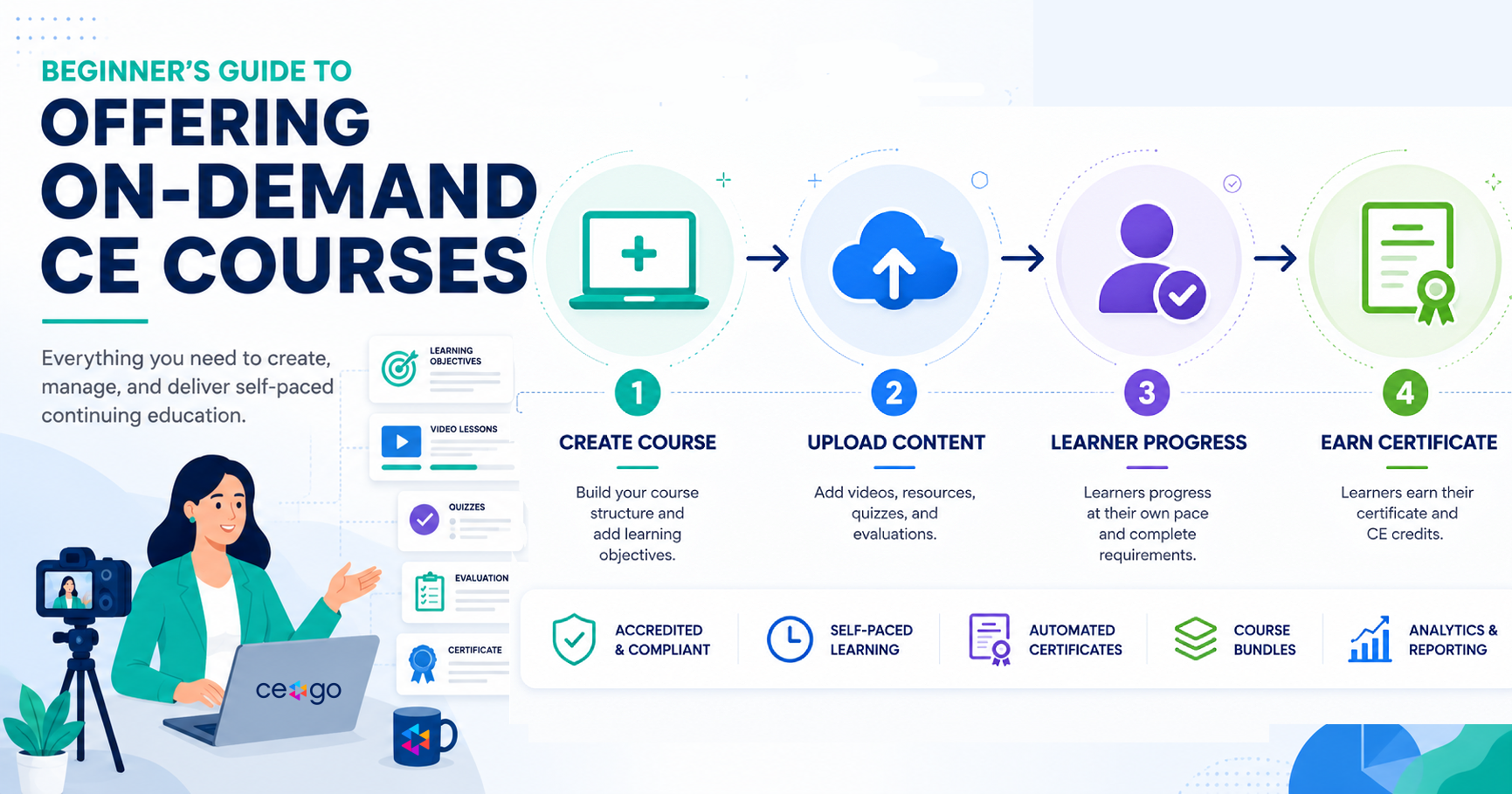
Live events are a great way to deliver continuing education, but they have a real limitation: attendees have to show up at a specific time. For busy professionals juggling patient loads, case files, or clinical schedules, that is not always possible. On-demand CE courses solve that problem by letting learners complete their credits on their own schedule, at their own pace.
If you have been thinking about adding a self-paced learning option to your CE programming, this guide covers everything you need to know to get started.
On-demand continuing education, sometimes called self-paced or distance learning, is any accredited CE activity that learners complete independently rather than attending a live session. Instead of logging in at a set time, participants access pre-recorded content, work through the material at their own pace, and pass a quiz to earn their credit.
The format is popular across healthcare, behavioral health, and allied health fields because it removes scheduling barriers without sacrificing educational quality. For providers, it also means your content keeps delivering value long after you finished creating it.
A wide range of organizations offer self-paced continuing education, including:
If your organization already runs live CE events, adding an on-demand component is often a natural next step. A live webinar or conference session you have already recorded can be turned into a self-paced course, which lets that content keep working for you long after the live date and turns a one-time event into an ongoing revenue stream.
The mechanics are straightforward, though there are a few moving parts to think through before you launch.
The core of any on-demand course is the learning content itself. This is typically a pre-recorded video, a slide presentation with narration, or a combination of both. Some providers also include downloadable resources like handouts or reference materials. The key requirement from most accrediting bodies is that the content is equivalent in scope and rigor to what you would deliver in a live setting.
Because no one is monitoring attendance in real time, on-demand courses need another way to confirm that a learner actually engaged with the material. One of the most effective methods is to require that learners watch the full video before they can move on. You can set a course up so that a registrant must complete each portion of the content before the next section or the quiz unlocks, which prevents anyone from skipping ahead to claim credit they did not earn.
On top of that, learners pass a quiz to earn their credit, and the quiz is what unlocks the certificate. Some accrediting bodies have specific requirements around passing scores or the number of questions, so it is worth checking the standards for your particular credit type.
Once a learner completes the required steps, they should receive a certificate that includes the activity title, credit amount, credit type, completion date, and the appropriate accreditation statement. This can be automated so certificates are delivered immediately after requirements are met, which learners appreciate and which saves your team significant administrative time.
You will need to decide how long your course is available. Some providers set a fixed window (six months or a year), while others offer open-ended access. You also need to consider whether the course is free, paid, or restricted to certain audiences, and how learners will register and access it.
You do not have to sell every course on its own. Once you have a few self-paced activities built, you can group related courses into a bundle and offer them together, often at a discounted rate. Bundling is useful for organizing offerings around a theme, and it works especially well for certificate programs where learners are expected to complete a full curriculum rather than a single session. It also gives you a simple way to increase the value of each registration.
Most CE credit types can be offered in a self-paced format, but the rules vary by accrediting body. Here are some of the most common:
There are two ways to handle accreditation, and CE-Go supports both. If your organization or you as an individual presenter already hold your own approvals, you can use CE-Go as the platform to build, deliver, and manage your self-paced courses while issuing credit under your own accreditation. If you do not hold your own approvals, CE-Go holds the accreditations and can extend them to your activity, so you can offer recognized CE credits without going through the lengthy and expensive process of becoming an approved provider yourself. Either way, if you are unsure whether your content qualifies for on-demand delivery under a specific credit type, that is a good thing to confirm before you build the course.
A few practical differences are worth understanding before you build your first course.
Live events verify attendance through check-in, sign-in sheets, or session logins. On-demand courses rely on a different proxy for engagement: requiring learners to work through the full content and then pass a quiz. This is why the completion controls and the quiz matter so much. A learner should not be able to jump straight to the quiz, and the quiz itself should be substantive enough to confirm they engaged with the material.
Live events also tend to have a defined start and end, which makes credit calculation simple. For on-demand courses, credit hours are typically calculated based on the documented length of the content, sometimes using a formula defined by the accrediting body. Keep records of how you calculated your credit hours in case you are ever audited.
Finally, live events generate attendance data in real time. On-demand courses require you to track completions systematically, and that data needs to be reportable. Your platform should be doing this for you automatically.
If you are ready to launch your first on-demand CE course, here is a practical starting point:
Yes, and it is one of the smartest ways to get more out of content you have already produced. A webinar you hosted once can become a self-paced course that keeps enrolling learners and generating revenue indefinitely. The main considerations are content quality (recordings should be clear and professional), whether any live Q&A portions need to be edited out or replaced, and confirming the accreditation covers the self-paced format.
Not necessarily. If your organization or you as a solo presenter already hold your own approvals, you can run your self-paced courses on CE-Go and issue credit under your own accreditation. If you do not hold your own approvals, becoming an accredited provider is a lengthy and expensive process, and you do not have to take it on: CE-Go holds the accreditations and can extend them to your activity, so you can offer recognized CE credits while focusing on the content rather than the compliance process.
You can require learners to watch the full video before they move forward. CE-Go lets you set a course up so that a registrant must complete each portion of the content before the next section or the quiz becomes available. This keeps learners from jumping ahead to the quiz, which helps you meet engagement requirements and stand up to an audit. The specific controls you use should match what your accrediting body requires.
Yes. Many organizations offer a mix of free and paid on-demand content. Paid courses can generate revenue that helps offset the cost of producing and delivering your content, and bundling related courses gives you another way to add value. Your platform should make it easy to set pricing, manage orders, and issue receipts alongside certificates.
On-demand continuing education is one of the most effective ways to extend the reach of your programming, serve professionals who cannot attend live events, and build a lasting library of accredited content. Once the infrastructure is in place, each new course you add gets easier to launch.
CE-Go's platform makes it straightforward to set up self-paced learning activities, require full completion before learners move ahead, automate certificate delivery, track completions, bundle related courses, and host everything on a branded Course Portal where learners can return to access their certificates and keep track of their credits. Whether you hold your own approvals or need CE-Go to extend its accreditations to your activity, you have one point of contact from setup through credit delivery.
If you are curious about what that looks like in practice, we would love to show you.
Schedule a demo today and see how CE-Go can help you build and manage your on-demand CE program.


